
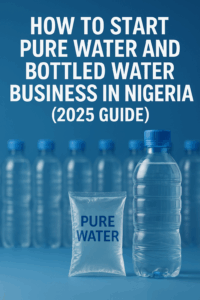
1. Introduction on How to Start Pure Water and Bottled Water Business in Nigeria
Learning How to Start Pure Water and Bottled Water Business in Nigeria is paramount to provide clean and safe drinking water, which is a basic human necessity — yet, in Nigeria, millions still lack consistent access to it. This gap has created one of the most lucrative small and medium-scale business opportunities in the country: the pure water and bottled water business. Whether you plan to start a sachet (pure water) factory or venture into bottled water production, the potential for profit and long-term growth is enormous.
Over the past decade, Nigeria’s population has grown rapidly — exceeding 220 million — with urbanization increasing the need for affordable, hygienic, and accessible water sources. In many parts of the country, tap water is unsafe or unavailable, forcing individuals, offices, schools, and event organizers to rely on packaged drinking water for daily use. This steady demand makes the pure water and bottled water industry one of the most sustainable businesses in Nigeria today. Check also our comprehensive guide on How to Start a Restaurant Business in Nigeria (Step-by-Step).
Why the Water Business Remains Profitable
The water industry in Nigeria operates on high demand, high turnover, and relatively low wastage. A sachet of pure water sells for ₦20–₦30, while a bag (containing 20 sachets) goes for ₦250–₦350. Despite tight competition, the sheer volume of daily consumption ensures consistent profit for producers. Similarly, bottled water brands cater to a more premium market — offices, hotels, restaurants, and events — offering higher margins per unit.
Even with hundreds of producers across Nigeria, the market is far from saturated. In fact, as population density rises and consumer awareness of water quality increases, more people are shifting from unregulated water sources to NAFDAC-approved packaged water. This creates a perfect opportunity for entrepreneurs who can combine high-quality production, effective branding, and efficient distribution.
Pure Water vs Bottled Water — What’s the Difference?
Before diving into the business setup, it’s essential to understand the difference between these two major product types:
- Pure Water (Sachet Water): This is filtered and treated water packaged in transparent 50cl sachets, commonly sold in bags. It requires less startup capital and is the most common entry point for beginners.
- Bottled Water: This is treated water packaged in PET bottles (50cl, 75cl, 1L, or 1.5L). It targets middle- and upper-income consumers and requires a higher investment due to the costs of bottling machines, labeling, and marketing.
Both categories can operate under one brand — meaning you can start small with sachet water and expand into bottled water as your profits grow.
Economic and Social Importance
Beyond profitability, the pure water and bottled water business contributes significantly to Nigeria’s economy by:
- Creating jobs for factory workers, drivers, marketers, and retailers.
- Supporting local manufacturing (plastic bottle, nylon, and packaging industries).
- Improving public health through safer drinking water distribution.
This blend of financial gain and social impact makes it one of the few businesses that remain viable in both rural and urban communities across Nigeria.
A Growing Industry You Can Join
Whether you are an aspiring entrepreneur, investor, or existing business owner seeking diversification, venturing into the water production business is a smart decision. With proper planning, compliance, and management, you can turn this essential commodity into a thriving and scalable enterprise.
In the following sections, we’ll explore everything you need to know — from market analysis and cost breakdown to NAFDAC registration, branding, and profitability tips — to help you confidently start your own pure water and bottled water business in Nigeria.
2. Understanding the Nigerian Water Market
Before investing your hard-earned money in the pure water and bottled water business, you need to understand the market structure, demand patterns, competition, and consumer behavior. Nigeria’s water market is vast and constantly expanding, driven by population growth, inadequate public water supply, and the rising health awareness of consumers.
2.1 Overview of the Nigerian Water Industry
Nigeria’s water industry can be broadly divided into three main segments:
- Sachet (Pure) Water
- Bottled Water
- Dispenser or Bulk Water (Refill Stations)
Each segment serves a unique class of consumers and operates at different investment scales.
- Sachet water dominates rural and low-income urban markets because it is cheap and widely available.
- Bottled water serves middle- and upper-income earners, hotels, restaurants, and events.
- Dispenser water targets offices, schools, and health-conscious families seeking large-volume, purified water.
This multi-tier market ensures that anyone—regardless of capital—can enter at some level and expand gradually.
2.2 Market Demand and Consumption Trends
Nigeria consumes billions of sachets and bottles of water every year. According to data from the National Bureau of Statistics (NBS) and industry reports, the packaged water market grows by an estimated 8–12% annually. The reasons are simple:
- Urbanization and population growth have increased water consumption.
- Most state water boards cannot meet domestic water needs.
- Concerns about waterborne diseases have led people to prefer packaged water.
In major cities like Lagos, Abuja, Port Harcourt, Kano, and Ibadan, the demand is extremely high. Even in rural areas, sachet water has become the default choice for drinking water because it is affordable and easy to distribute.
2.3 The Competition: Who Are the Major Players?
While thousands of small-scale producers operate across Nigeria, a few major brands dominate the premium bottled water segment, including:
- Eva Water (produced by Coca-Cola)
- Nestlé Pure Life
- Aquafina (by Seven-Up Bottling Company)
- Ragolis Natural Water
- SWAN Table Water
- La Sien Water
These large companies serve urban supermarkets, hotels, and corporate clients.
However, the pure water segment remains decentralized — meaning smaller producers can easily enter the market, serve local communities, and still make steady profits. Most pure water factories operate within a 10–20 km delivery radius, making local dominance achievable even with modest investment.
2.4 Opportunities in the Market
Despite the growing number of producers, Nigeria’s water market remains underserved in many regions. Key opportunities include:
- Rural and semi-urban markets: Many small towns still rely on borehole or stream water, which is often unsafe. Setting up a mini sachet factory in such areas can yield quick profits.
- Corporate and institutional supply: Offices, schools, and hospitals need reliable suppliers of bottled and dispenser water.
- Custom-labeled water: Event planners, hotels, and religious organizations often demand branded bottled water for events — a growing niche market.
- Distribution partnerships: Entrepreneurs can also earn income by handling transportation and retail distribution for manufacturers.
2.5 Factors Driving the Market Growth
- Urbanization: As people move to cities, the demand for portable, clean water increases.
- Health Awareness: Nigerians are becoming more conscious of waterborne diseases like typhoid and cholera.
- Climate and Environment: Hot weather conditions make hydration essential throughout the year.
- Economic Realities: With affordable sachets and bottles, packaged water remains a basic daily need, regardless of inflation.
The Nigerian water market is large, dynamic, and profitable — yet open enough for new entrants who understand quality, consistency, and branding. Whether you choose to start a pure water factory or a bottled water brand, success depends on meeting consumer expectations of hygiene, taste, and reliability.
3. Why Start a Pure Water and Bottled Water Business in Nigeria
Starting a pure water or bottled water business in Nigeria is not just a response to market demand — it’s one of the most sustainable, profitable, and socially impactful ventures you can invest in today. Every household, school, office, and event needs clean drinking water daily. This constant demand makes the business both recession-proof and scalable.
Below are the major reasons why entering the water production industry in Nigeria is a smart move in 2025 and beyond.
3.1. Ever-Growing Demand for Safe Drinking Water
Access to clean drinking water remains a major challenge across Nigeria. In most urban centers, public water supply systems are unreliable or completely absent. Many households depend on boreholes, wells, and streams, which are often contaminated.
Because of this, millions of Nigerians rely on sachet (“pure”) water and bottled water as their main source of drinking water. Whether it’s for daily hydration, events, or travel, packaged water has become a daily necessity — not a luxury. This continuous need guarantees a stable customer base throughout the year.
Quick Fact: According to the National Bureau of Statistics, over 70% of Nigerian households buy pure water daily — a clear indicator of steady market demand.
3.2. High Profit Potential
The water business offers impressive profit margins when well-managed.
For example:
- A bag of pure water costs about ₦150–₦180 to produce and sells for ₦250–₦350, depending on the location.
- Bottled water costs roughly ₦700–₦900 per 12-pack carton and sells for ₦1,200–₦1,500.
With consistent production and strong distribution, small factories can make ₦200,000 to ₦500,000 monthly profit — or even more for medium-scale operations. Unlike perishable goods, water doesn’t spoil, making inventory management simple and losses minimal.
3.3. Low Entry Barrier (Start Small and Scale Up)
Unlike heavy industries that require multimillion-dollar investments, the water business is flexible. You can start small with a sachet water line and gradually expand into bottled water production once profits increase.
For instance:
- A mini sachet water factory can start with ₦2–₦5 million.
- A medium-scale bottled water plant may require ₦10–₦20 million, depending on equipment quality.
Many successful bottled water brands in Nigeria today began as small sachet producers before expanding — proving that growth in this sector is highly achievable.
3.4. Constant Cash Flow
Pure water and bottled water are fast-moving consumer goods (FMCG). People buy daily, meaning your business generates income regularly — not seasonally. Events, offices, schools, and retail shops create steady bulk demand, allowing for predictable revenue.
Even during economic downturns, people still prioritize water purchases, making it one of the most reliable sources of daily cash flow in Nigeria’s business environment.
3.5. Employment and Economic Contribution
The water production industry provides jobs across multiple sectors:
- Factory workers handle packaging and sealing.
- Drivers and distributors ensure supply to retailers.
- Retail sellers make a daily profit by reselling.
- Technicians install and maintain machinery.
By starting a water business, you’re not only earning income but also supporting local job creation and boosting the economy.
3.6. Scalability and Expansion Opportunities
Once your water brand gains recognition, there are many ways to expand:
- Launch a bottled line under the same brand name.
- Introduce dispenser water (19L refills) for offices and institutions.
- Diversify into flavored or alkaline water for health-conscious consumers.
- Franchise or open distribution depots in other cities.
Because the product is essential and easy to transport, scaling up is straightforward once your production and marketing systems are stable.
3.7. Positive Social and Health Impact
Beyond the profits, producing clean water helps reduce waterborne diseases like typhoid and cholera — especially in low-income communities. You’ll be providing a public health solution while building a trusted brand that stands for hygiene and quality.
Starting a pure water and bottled water business in Nigeria offers both financial security and social value. With an increasing population, weak public water supply, and rising hygiene awareness, the market’s growth shows no sign of slowing down. It’s one of the few ventures where demand always exceeds supply, making it a smart choice for entrepreneurs looking for a stable, profitable, and impactful investment.
4. Feasibility Study and Business Plan for Pure Water and Bottled Water Business in Nigeria
Before investing in a pure water or bottled water venture, it’s vital to conduct a comprehensive feasibility study and develop a solid business plan. These two tools will help you understand your market, estimate costs, forecast profits, and prepare for the challenges ahead. Many water factories fail not because the idea is bad, but because the owners didn’t plan properly before starting.
Let’s break down what your feasibility study and business plan should include.
4.1. What Is a Feasibility Study?
A feasibility study is a detailed market and financial analysis that helps you determine whether your business idea is viable. It answers questions like:
- Is there enough demand for pure or bottled water in your area?
- Who are your competitors, and what are their prices?
- What are your startup and running costs?
- How long will it take to recover your investment?
By completing a feasibility study, you’ll identify potential risks early and design strategies to minimize them before you start production.
4.2. Why You Need a Business Plan
Your business plan is your operational blueprint — it outlines your goals, strategies, and financial projections. It’s not only for internal guidance but also essential when seeking funding or partnerships.
Banks, investors, and government agencies (like BOI or SMEDAN) will require a well-documented business plan to evaluate your seriousness and financial preparedness.
4.3. Key Components of a Water Business Plan
Below is a breakdown of what your business plan should include:
1. Executive Summary
Provide an overview of your business concept — whether you’re producing sachets, bottles, or both. Include your mission, goals, and target market. Example:
“AquaLife Nigeria Limited aims to produce affordable, hygienic, and NAFDAC-approved drinking water to meet the daily hydration needs of urban and rural Nigerians.”
2. Company Description
Explain your ownership structure (sole proprietorship, partnership, or limited liability). Highlight your location advantage, business registration details (CAC), and long-term vision.
3. Market Analysis
Present findings from your feasibility study:
- Current demand in your target area.
- Key competitors (names, prices, and scale).
- Consumer purchasing behavior.
- Distribution channels available.
Example: In Lagos Mainland alone, over 2 million sachets are consumed daily. Yet, most neighborhoods still rely on 2–3 suppliers, showing high potential for new entrants.
4. Product Description
Clearly describe your product lines:
- Sachet (pure) water — 50cl sealed packs.
- Bottled water — 50cl, 75cl, 1L, and 1.5L sizes.
- Optional: Dispenser/refill water (19L).
Include your planned packaging, labeling, and quality assurance process.
5. Operational Plan
Explain how your business will operate daily:
- Source of raw water (borehole or municipal).
- Treatment and purification method (filtration, UV sterilization, reverse osmosis).
- Machinery setup and staff roles.
- Distribution plan (company trucks, retailers, or wholesalers).
6. Marketing and Sales Strategy
Describe how you intend to reach customers:
- Branding and logo design.
- Social media marketing (Instagram, Facebook, WhatsApp).
- Bulk supply to offices, events, and schools.
- Retail distribution via shops, hawkers, and markets.
Include pricing strategy, promotions, and customer retention plans.
7. Management and Staffing
List your team structure:
- General Manager / CEO
- Production Supervisor
- Machine Operators
- Quality Control Officer
- Driver / Logistics Officer
- Sales & Marketing Staff
Even for small factories, trained personnel are critical to maintaining consistent product quality.
8. Financial Plan
Provide a detailed financial forecast, including:
- Startup capital estimate.
- Cost of equipment, registration, and branding.
- Monthly expenses (raw materials, salaries, electricity, fuel).
- Expected sales volume and profit margin.
- Break-even analysis and ROI period.
4.4. Estimated Startup Capital Breakdown
Here’s a sample cost estimate (as of 2025 rates):
| Item | Estimated Cost (₦) |
| Borehole drilling & water treatment system | 1,500,000 – 3,000,000 |
| Sachet/bottle sealing & packaging machines | 1,000,000 – 2,500,000 |
| Generator (industrial) | 700,000 – 1,500,000 |
| NAFDAC registration & licensing | 200,000 – 500,000 |
| Factory rent & renovation | 500,000 – 1,500,000 |
| Delivery vehicle or tricycle | 800,000 – 2,000,000 |
| Branding, labels, & packaging materials | 300,000 – 700,000 |
| Staff salaries (3–6 months) | 600,000 – 1,000,000 |
| Miscellaneous & contingencies | 300,000 – 500,000 |
Total Estimated Cost: ₦5 million – ₦12 million (depending on scale).
Start small if you lack capital — a sachet-only factory can begin operations with as little as ₦2 million using locally fabricated equipment.
4.5. Profit Projection Example
If you produce 1,000 bags per day and sell at ₦300 each:
- Daily revenue: ₦300,000
- Monthly revenue (25 working days): ₦7.5 million
- Monthly expenses: ₦4–₦5 million
- Net profit: ₦2.5–₦3.5 million monthly
Your investment could be recovered within 6–12 months if managed efficiently.
A well-prepared feasibility study and business plan give you clarity, reduce risk, and attract investors. It helps you set realistic financial goals and build a clear roadmap from idea to operation. In Nigeria’s competitive water industry, planning is your biggest advantage.
5. Capital Requirements and Cost Breakdown for Pure Water and Bottled Water Business in Nigeria
One of the first questions aspiring entrepreneurs ask is:
“How much does it cost to start a pure water or bottled water business in Nigeria?”
The truth is — the required capital depends on the scale of operation, location, and type of water production you want to focus on (sachet, bottled, or both). This section provides a full financial breakdown to guide you on whether you’re starting small, medium, or large-scale.
5.1. Types of Water Business Setup
Before the cost breakdown, let’s identify the three main categories of water production setups in Nigeria:
| Category | Description | Estimated Capital (₦) |
| Small-scale (Sachet-only) | Focuses on producing pure water in sachets (50cl). | ₦2 million – ₦5 million |
| Medium-scale (Sachet + Bottle) | Produces sachet and bottled water for retail and events. | ₦8 million – ₦15 million |
| Large-scale (Automated Plant) | Fully automated bottled water line with high output. | ₦20 million – ₦50 million+ |
Each level comes with different machinery, production capacities, and regulatory costs.
5.2. Step-by-Step Cost Breakdown
Let’s take a detailed look at each startup expense and its purpose:
1. Borehole and Water Source Setup
- Purpose: Provides a steady supply of clean raw water.
- Cost: ₦1,500,000 – ₦3,000,000 (includes submersible pump, storage tanks, plumbing, and initial testing).
Ensure your borehole is drilled deep enough (at least 150 feet) to avoid contamination from surface water.
2. Water Treatment System
- Purpose: To purify water through filtration, UV sterilization, and reverse osmosis.
- Components: Sand filter, carbon filter, micron filter, UV light, RO membrane, and pressure tanks.
- Cost: ₦700,000 – ₦2,000,000 depending on capacity.
A typical pure water line uses 3–5 filtration stages, while bottled water requires 6–8 for higher purity.
3. Production Machines
- Sachet Water Sealing Machine (Automatic): ₦600,000 – ₦1,500,000
- Bottle Blowing Machine: ₦2,000,000 – ₦5,000,000
- Filling and Capping Machine: ₦1,000,000 – ₦2,000,000
- Shrink Wrapping/Packaging Machine: ₦500,000 – ₦1,000,000
Locally fabricated machines are cheaper but may require more maintenance, while imported ones offer higher precision and speed.
4. Generator / Power Supply
Power supply is a major cost factor.
- Industrial Generator (20–40 KVA): ₦800,000 – ₦1,800,000
- Alternative (Solar/Hybrid System): ₦3 million+ (optional for long-term savings)
Consistent power ensures uninterrupted production, especially during peak demand seasons.
5. Factory Space and Renovation
You’ll need a clean, ventilated, and well-tiled facility divided into sections (production, packaging, storage, and office).
- Factory Rent: ₦500,000 – ₦1,500,000 yearly
- Renovation & Partitioning: ₦300,000 – ₦800,000
Choose a location with access roads for delivery trucks and proximity to your main market.
6. NAFDAC and Other Registrations
- NAFDAC Registration: ₦150,000 – ₦350,000
- CAC Business Registration: ₦50,000 – ₦100,000
- Environmental/Local Government Permits: ₦30,000 – ₦100,000
Regulatory approval is mandatory before you can legally sell your products. Ensure your water passes lab tests and meets NAFDAC hygiene standards.
7. Packaging and Branding
This includes:
- Nylon rolls (for sachets)
- Bottle labels and caps
- Branded bags and cartons
- Logo design and company identity
Cost: ₦300,000 – ₦700,000 (initial setup)
Good branding boosts customer trust and makes your product stand out in the market.
8. Delivery Vehicles
Transportation is crucial for distribution.
- Mini Truck / Bus: ₦1,200,000 – ₦3,000,000
- Tricycle (Keke for short distance): ₦600,000 – ₦900,000
You can start with one vehicle and expand as your customer base grows.
9. Staffing and Salaries (First 3–6 Months)
You’ll need:
- Production workers (2–3)
- Machine operator
- Driver/loader
- Sales rep/marketer
- Supervisor/manager
Estimated Cost: ₦500,000 – ₦1,000,000
10. Miscellaneous & Working Capital
Include expenses like maintenance, packaging materials, water testing, diesel, and emergency repairs.
Budget: ₦300,000 – ₦500,000
5.3. Total Estimated Startup Capital (2025)
| Business Type | Estimated Capital (₦) |
| Sachet Water Factory (Small Scale) | ₦2 million – ₦5 million |
| Sachet + Bottled Water Factory (Medium Scale) | ₦8 million – ₦15 million |
| Fully Automated Bottled Water Plant (Large Scale) | ₦20 million – ₦50 million+ |
5.4. Funding Options
If you don’t have the full capital, consider these funding sources:
- Bank of Industry (BOI) Loans – low-interest MSME financing.
- SMEDAN Grants & Support Programs.
- Cooperative societies or family partnerships.
- Private investors or angel funding.
Always prepare a well-written business plan before applying for any funding or grant.
Starting a pure water and bottled water business in Nigeria requires careful financial planning, but the returns are worth the investment. With ₦2 million–₦5 million, you can start a small sachet factory and gradually expand into bottled water as your profits grow. Proper budgeting, cost control, and quality assurance will ensure long-term success.
6. Equipment and Machinery Needed for Pure and Bottled Water Production in Nigeria
To operate a successful pure water or bottled water business in Nigeria, you must invest in the right equipment and machinery. These machines determine your production capacity, water quality, and overall profitability. The goal is to maintain consistent purity and packaging standards that meet NAFDAC and WHO requirements.
Below is a detailed guide to all the essential machines, their functions, and estimated prices in Nigeria (as of 2025).
6.1 Essential Equipment for Sachet (Pure) Water Production
Sachet water production is the most common entry point for entrepreneurs with small to medium capital. The major equipment required includes:
1. Borehole and Water Storage Tank
- Function: Source of raw water supply for treatment.
- Specification: At least 100 feet deep borehole with 1–2 overhead tanks (1,000–2,000 liters each).
- Estimated Cost: ₦500,000 – ₦1,500,000 depending on location and water depth.
2. Water Treatment Plant
- Function: Purifies raw borehole water by removing iron, bacteria, odor, and sediments.
- Components include:
- Sand filter
- Carbon filter
- Micron filter
- UV sterilizer or ozone generator
- Estimated Cost: ₦700,000 – ₦2,500,000 depending on capacity and brand.
3. Pure Water Production Machine (Sachet Packing Machine)
- Function: Automatically fills, seals, and cuts sachets into standard 50cl bags.
- Types:
- Automatic (more efficient, higher output)
- Semi-automatic (cheaper but slower)
- Estimated Cost: ₦1,200,000 – ₦2,500,000.
- Output Capacity: 1,200–2,500 sachets/hour.
4. Nylon Printing Machine (Optional)
- Function: Prints your brand name, NAFDAC number, and production details on sachet rolls.
- Alternative: Outsource nylon printing to reduce start-up costs.
- Estimated Cost: ₦300,000 – ₦600,000.
5. Generator (Industrial Capacity)
- Function: Powers the machines during power outages (which are frequent in Nigeria).
- Recommended: 20–30 KVA diesel generator.
- Estimated Cost: ₦1,000,000 – ₦2,000,000.
6. Bagging Table and Heat Sealer
- Function: Used for arranging and sealing bags of sachet water (usually 20 sachets per bag).
- Estimated Cost: ₦50,000 – ₦150,000.
7. Delivery Van (Optional but Useful)
- Function: Distributes finished products to retailers and vendors.
- Estimated Cost: ₦2,500,000 – ₦5,000,000 (new or used minivan).
6.2 Equipment for Bottled Water Production
Bottled water production requires more advanced machinery, as it involves bottle molding, washing, filling, and capping. The key equipment includes:
1. Automatic Bottle Blowing Machine
- Function: Molds plastic preforms into bottles using heat and air pressure.
- Capacity: 1,000–2,000 bottles per hour.
- Estimated Cost: ₦2,500,000 – ₦5,000,000.
2. Bottle Washing, Filling, and Capping Machine (3-in-1 Line)
- Function: Automatically washes, fills, and caps bottles in one process.
- Estimated Cost: ₦3,000,000 – ₦8,000,000.
- Output: 1,000–5,000 bottles/hour, depending on model.
3. Labeling and Shrinking Machine
- Function: Wraps branded labels on bottles and seals them with heat for a professional finish.
- Estimated Cost: ₦800,000 – ₦1,500,000.
4. Reverse Osmosis (RO) Water Treatment System
- Function: Provides the highest purification standard by filtering water at a molecular level.
- Recommended for: Premium bottled water production.
- Estimated Cost: ₦2,000,000 – ₦4,500,000.
5. Bottle Packaging Machine
- Function: Shrink-wraps bottles into packs of 12 or 20 for easy distribution.
- Estimated Cost: ₦800,000 – ₦1,800,000.
6.3 Factory Layout and Equipment Arrangement
A standard pure water factory is divided into key sections:
- Raw Water Room: Borehole and storage tanks.
- Treatment Room: Filters, sterilizers, and treatment systems.
- Production Room: Sachet or bottle filling and sealing machines.
- Packaging Area: Bagging or boxing of finished products.
- Storage Area: Temporary storage before distribution.
- Office and Quality Control Unit: For record-keeping and sample testing.
Tip: NAFDAC requires your production and storage rooms to have tiled floors, adequate drainage, and insect-proof windows to maintain hygiene.
6.4 Cost Summary of Equipment Setup (2025 Estimate)
| Equipment Type | Pure Water Factory | Bottled Water Factory |
| Borehole & Tank | ₦1,000,000 | ₦1,000,000 |
| Water Treatment | ₦1,500,000 | ₦3,500,000 |
| Production Machine | ₦2,000,000 | ₦6,000,000 |
| Generator | ₦1,500,000 | ₦2,500,000 |
| Nylon/Label Printing | ₦400,000 | ₦1,000,000 |
| Packaging Equipment | ₦150,000 | ₦1,000,000 |
| Vehicle | ₦3,000,000 | ₦4,000,000 |
| Total Estimate | ₦9M – ₦12M | ₦18M – ₦25M |
These costs vary depending on brand, capacity, and whether you import directly from China or buy locally from distributors in Lagos, Onitsha, or Aba.
Investing in quality machinery is the foundation of a successful water business. Cheap or substandard equipment leads to frequent breakdowns, inconsistent water quality, and production delays. Always purchase from verified suppliers, and ensure all machines are installed by certified technicians to meet NAFDAC standards.
7. Step-by-Step Process of Producing Pure and Bottled Water in Nigeria
Producing pure (sachet) water and bottled water in Nigeria follows a strict process designed to ensure clean, safe, and high-quality drinking water. Whether you are starting small or planning a large-scale factory, understanding each stage of production helps you maintain NAFDAC compliance and build a trusted brand.
Let’s break down the complete production process for both sachet and bottled water step by step.
7.1 Step 1: Water Sourcing
Every production starts with sourcing raw water, typically from a borehole, municipal supply, or natural spring.
Requirements:
- The borehole should be at least 100–150 feet deep to ensure clean underground water.
- Water must be tested in a certified laboratory before use.
- Avoid locations near drainage, refuse dumps, or fuel stations to prevent contamination.
Always keep your water source within your factory compound to reduce contamination risk and water transport costs.
7.2 Step 2: Water Treatment and Purification
Raw water from boreholes contains impurities such as iron, calcium, bacteria, and odor. The water treatment stage removes these impurities and ensures the water is safe for human consumption.
Common Treatment Processes:
- Coarse Filtration: Removes large particles, sand, and dirt.
- Carbon Filtration: Eliminates color, odor, and chlorine.
- Micron Filtration: Filters fine particles and sediments.
- Reverse Osmosis (RO): Advanced purification process that removes dissolved solids and heavy metals.
- Ultraviolet (UV) Sterilization or Ozone Treatment: Kills bacteria, viruses, and microorganisms.
Each stage must be maintained regularly to ensure consistent water quality.
7.3 Step 3: Water Testing and Quality Control
Before packaging, your treated water must be tested regularly to meet NAFDAC and World Health Organization (WHO) standards.
Tests to Conduct:
- pH Level: Should be between 6.5 and 8.5
- Total Dissolved Solids (TDS): Less than 500 mg/L
- Microbiological Test: Must be free from E. coli, coliform, and other pathogens
- Taste and Odor Test: Should be odorless and colorless
Maintain a small quality control laboratory within your factory for periodic in-house tests and record-keeping.
7.4 Step 4: Packaging and Sealing Process
For Sachet (Pure) Water:
- The treated water is pumped into the sachet packaging machine.
- The machine automatically fills, seals, and cuts the water into 50cl sachets.
- Sachets are counted manually or automatically and packed in bags of 20 sachets each.
- Each bag is sealed using a heat sealer and arranged for distribution.
For Bottled Water:
- Bottles are first molded or purchased and washed thoroughly using the bottle washing machine.
- Treated water is filled using the bottle filling and capping machine (3-in-1 system).
- After capping, bottles go through labeling and shrink-wrapping machines.
- Finished bottles are arranged into cartons or packs for sale.
Ensure your packaging area is clean, well-lit, and separated from the treatment and storage rooms.
7.5 Step 5: Branding and Labeling
Your product’s branding and label design play a key role in attracting customers and gaining market trust.
Your label must include:
- Brand name and logo
- NAFDAC registration number
- Batch number and manufacturing date
- Expiry date (usually 6–12 months)
- Contact information and production address
- Volume (e.g., 50cl, 75cl, 1.5L)
Invest in a professional label design. Clean, modern packaging can help you stand out in a crowded market.
7.6 Step 6: Storage and Distribution
Once packaged, products are stored in a clean, dry, and ventilated warehouse.
Avoid direct sunlight or contact with the floor.
For distribution:
- Pure water is usually sold in wholesale quantities (20 sachets per bag).
- Bottled water is supplied to supermarkets, event centers, offices, and retailers.
Distribution Channels Include:
- Wholesalers and retailers in open markets
- Event planners and hotels
- Corporate supply contracts
- Door-to-door distribution via branded delivery vans
Always maintain a distribution schedule to ensure your products reach the market fresh and consistent.
7.7 Step 7: Record Keeping and Quality Maintenance
Keep records of:
- Daily production output
- Sales and distribution logs
- Water test reports
- Equipment maintenance schedules
NAFDAC inspectors may request these records at any time during routine inspections.
The success of your water business depends on strict adherence to production standards and consistent quality control. Cleanliness, regular testing, and modern packaging are what differentiate a trusted water brand from competitors. If you can ensure steady water quality and attractive packaging, your brand will easily dominate your local market.
8. Cost Analysis and Profitability of Pure and Bottled Water Business in Nigeria (2025 Estimate)
Before starting a pure water or bottled water business, it’s crucial to understand the startup costs, operational expenses, and expected profit margin.
This helps you determine your financial readiness, plan efficiently, and forecast returns on investment (ROI).
This section breaks down both pure (sachet) and bottled water business costs in Nigeria as of 2025, using practical estimates based on current market prices.
8.1 Start-Up Cost for Sachet (Pure) Water Business
Below is an estimated budget breakdown for setting up a small to medium-scale pure water factory in Nigeria:
| Item Description | Estimated Cost (₦) |
| Borehole Drilling and Water Tank Installation | 1,000,000 |
| Water Treatment Plant | 1,500,000 |
| Sachet Water Packaging Machine | 2,000,000 |
| Generator (20–30 KVA) | 1,500,000 |
| Nylon Printing (Branded Rolls) | 400,000 |
| Factory Renovation & Plumbing | 800,000 |
| NAFDAC Registration and Licensing | 150,000 |
| CAC and Tax Registration | 50,000 |
| Furniture, Office Setup & Quality Control Tools | 300,000 |
| Delivery Van (Used Mini Truck) | 3,000,000 |
| Staff Salaries (First 3 Months) | 500,000 |
| Miscellaneous & Contingencies | 300,000 |
| Total Estimated Startup Cost | ₦11,500,000 |
You can start smaller (₦5–7 million) by renting a facility, outsourcing nylon printing, or using manual sealing machines before scaling.
8.2 Start-Up Cost for Bottled Water Business
Bottled water requires higher investment due to additional machinery and branding expenses.
| Item Description | Estimated Cost (₦) |
| Borehole & Overhead Tanks | 1,000,000 |
| Reverse Osmosis (RO) Treatment System | 3,500,000 |
| Bottle Blowing Machine | 4,000,000 |
| Bottle Washing, Filling & Capping Line | 6,000,000 |
| Labeling & Shrink-Wrapping Machine | 1,200,000 |
| Generator (Industrial Grade) | 2,000,000 |
| Factory Setup & Plumbing | 1,000,000 |
| NAFDAC, CAC, and Tax Registration | 200,000 |
| Branding, Label Design & Printing | 500,000 |
| Delivery Vehicle | 4,000,000 |
| Staff Salaries (First 3 Months) | 700,000 |
| Miscellaneous | 500,000 |
| Total Estimated Startup Cost | ₦24,600,000 |
You can reduce costs by buying used or locally assembled machines in Aba, Onitsha, or Lagos.
8.3 Monthly Operational Expenses (Sachet Water)
| Expense Type | Monthly Cost (₦) |
| Raw Materials (Nylon, Packaging) | 300,000 |
| Electricity and Fuel | 250,000 |
| Labor and Staff | 150,000 |
| Vehicle Maintenance and Transport | 100,000 |
| Borehole and Equipment Maintenance | 50,000 |
| Miscellaneous | 50,000 |
| Total Monthly Expense | ₦900,000 |
8.4 Revenue and Profit Projection (Sachet Water)
Let’s assume:
- You produce 1,500 bags per day.
- You sell each bag at ₦250 (wholesale price).
- You operate 26 days per month.
Monthly Revenue = 1,500 bags × ₦250 × 26 days = ₦9,750,000
Net Profit = ₦9,750,000 – ₦900,000 = ₦8,850,000 (gross profit before tax and depreciation).
Even after accounting for taxes and repairs, most factories make ₦6–₦7 million monthly at this scale.
8.5 Revenue and Profit Projection (Bottled Water)
Assume:
- You produce 2,000 bottles per hour, running 8 hours daily.
- You sell each 50cl bottle at ₦80 wholesale.
- You operate 26 days per month.
Monthly Revenue = 2,000 × ₦80 × 8 × 26 = ₦33,280,000
Operational Cost = ₦6,000,000 – ₦8,000,000/month (fuel, staff, logistics, packaging).
Net Profit = ₦25,000,000+ monthly (large-scale producers).
Smaller bottled water plants may earn ₦2–₦5 million monthly, depending on output and market coverage.
8.6 Factors That Influence Profitability
- Location: Urban centers like Lagos, Abuja, Port Harcourt, and Kano have higher demand and better distribution networks.
- Water Quality: High-quality, great-tasting water leads to customer retention.
- Branding and Packaging: Attractive designs and strong names build trust and justify higher prices.
- Distribution Efficiency: Timely supply to retailers improves turnover.
- Power Source: Factories with solar or hybrid systems save heavily on fuel costs.
- Maintenance: Well-maintained machines reduce downtime and waste.
8.7 Return on Investment (ROI)
Depending on your scale, the average ROI for the water business is impressive:
| Business Type | Capital Range (₦) | Average Monthly Profit (₦) | ROI Period |
| Small Sachet Water Plant | 5M–10M | 800K–2M | 6–12 Months |
| Medium Sachet Water Plant | 10M–15M | 3M–5M | 5–8 Months |
| Bottled Water Factory | 18M–25M | 4M–10M | 8–15 Months |
With steady sales and good management, you can recover your full investment in under one year and scale up easily.
The pure and bottled water business is one of Nigeria’s most lucrative and recession-proof ventures. With proper planning, standard equipment, and quality control, investors can achieve fast ROI and steady profits.
Even with inflation and fuel challenges, the high daily demand for safe drinking water ensures this industry remains profitable year-round.
9. Branding and Packaging
In a highly competitive industry like the water business, branding and packaging play a crucial role in differentiating your product from others on the market. Consumers are naturally drawn to clean, attractive, and professional-looking packaging — it signals trust, quality, and reliability.
Importance of Brand Identity in a Saturated Market
Your brand identity is more than just a name or logo; it’s the entire perception customers have of your business. With hundreds of pure water and bottled water brands across Nigeria, standing out requires a unique brand personality that reflects cleanliness, purity, and trust.
- Choose a memorable business name that conveys freshness (e.g., “CrystalPure,” “AquaLife,” or “BlueDrop”).
- Develop a professional logo that’s simple, clean, and easy to recognize from afar.
- Ensure consistency in color, font, and design across sachets, bottles, delivery vans, uniforms, and marketing materials.
- Position your brand around a message that connects emotionally — for example, “Purity in Every Drop” or “Nigeria’s Trusted Hydration.”
A well-crafted brand builds customer loyalty, encourages repeat sales, and makes your water brand easily recognizable even among competitors.
Designing Labels and Bottle Caps
For bottled water, labels and caps are not just functional — they are your silent salesmen. Nigerian consumers often equate good packaging with good quality.
- Use water-resistant label materials (like BOPP film) to prevent peeling and fading.
- Include essential details on labels: brand name, NAFDAC number, production date, expiry date, and contact info.
- Choose bright and calm colors like blue, white, and silver to convey purity and hygiene.
- Bottle caps should be tamper-evident, tightly sealed, and preferably branded with your logo. This not only prevents counterfeiting but also builds credibility.
Tips for Attractive and Durable Sachets
For sachet (pure) water producers, the packaging must be both appealing and functional:
- Use thick, high-quality nylon films (60–70 microns) to prevent leakage and bursting during distribution.
- Print your brand name, logo, and NAFDAC number clearly on each sachet.
- Avoid overcrowded designs — simplicity sells better and looks more professional.
- Keep sachets transparent enough to show clarity but opaque enough to highlight your branding.
- Consider adding short, catchy taglines like “Stay Hydrated. Stay Pure.”
Attractive sachets and bottles influence consumer trust — people tend to assume that clean packaging equals clean water.
Keywords:
- pure water packaging design
- bottled water branding Nigeria
- sachet water label design
- water business logo ideas
- how to brand bottled water in Nigeria
10. Marketing and Distribution Strategies
Starting a pure water or bottled water business in Nigeria goes beyond production — effective marketing and distribution determine how quickly your brand gains visibility, trust, and loyal customers. Since the market is highly competitive, your strategy should focus on reach, affordability, and reliability.
10.1. Develop a Strong Marketing Plan
A marketing plan helps you define your target customers and determine the best way to reach them. In Nigeria, the water business caters to diverse markets — households, shops, schools, offices, events, and street vendors.
- Identify your target audience: Decide if you’re focusing on retail consumers, wholesale distributors, or corporate clients.
- Set competitive prices: Keep prices affordable, but ensure your profit margin remains healthy.
- Promote your NAFDAC approval: Many Nigerians check for NAFDAC registration before purchasing water. Highlight it on your packaging and marketing materials.
- Leverage word-of-mouth: In local communities, referrals from trusted customers are your most powerful marketing tool.
10.2. Offline Marketing Techniques
Most pure water and bottled water sales in Nigeria still happen offline. Consider the following tactics:
- Branded distribution vans: Wrap your delivery vehicles with your logo, contact info, and slogan — they serve as moving billboards.
- Outdoor signage and banners: Place bold, visible signs near your factory, busy roads, and retail spots.
- Promotions and giveaways: Offer discounts or free samples during launch periods, religious events, and community gatherings.
- Partner with retailers and event planners: Build long-term relationships with shop owners, supermarkets, and event caterers who buy in bulk.
10.3. Online and Social Media Marketing
Even in traditional sectors like water production, an online presence builds credibility. Nigerians increasingly search online for reliable brands.
- Create a simple website with your company details, certifications, and contact information.
- Use social media platforms (especially Facebook, Instagram, and WhatsApp Business) to post product photos, factory videos, and customer testimonials.
- Run location-targeted ads to reach nearby buyers, distributors, and event organizers.
- Encourage customers to post photos or reviews — user-generated content builds trust fast.
10.4. Building a Distribution Network
Distribution efficiency determines how widely your product spreads.
- Recruit distributors and retailers: Offer wholesale discounts and branded materials (e.g., umbrellas, aprons, or banners).
- Use tricycles or mini-trucks for short-distance deliveries and reliable logistics.
- Create routes and delivery schedules — daily or weekly — depending on demand.
- Incentivize volume sales: Offer bonuses or discounts to distributors who hit sales targets.
Consistency in supply builds loyalty. A retailer who can always rely on your brand for prompt delivery is unlikely to switch suppliers.
10.5. Corporate and Institutional Clients
Target corporate offices, schools, hotels, restaurants, and event centers for bulk supplies of bottled water.
- Offer customized labels for events and branding campaigns.
- Provide monthly supply contracts with discounted rates.
- Maintain punctual delivery and top-notch customer service — reliability sets you apart.
10.6. Customer Relationship and Retention
- Keep communication open with distributors and end consumers.
- Train your delivery staff to be polite and professional.
- Encourage feedback and fix any issues immediately.
- Introduce loyalty programs — for example, offer a free pack after every 10 purchases.
11. Challenges in the Pure and Bottled Water Business (and How to Overcome Them)
Like any business in Nigeria, running a pure water and bottled water enterprise comes with its fair share of challenges. The key to long-term success lies in anticipating these challenges early and putting systems in place to overcome them efficiently.
Below are the most common problems water entrepreneurs face — and proven ways to tackle them:
1. Power Supply and High Energy Costs
Challenge: Irregular electricity is one of the biggest hurdles for water factories in Nigeria. Frequent power cuts interrupt production and increase operating costs since many producers rely on diesel or petrol generators.
Solution:
- Invest in energy-efficient machines to reduce fuel consumption.
- Use solar power systems to run basic operations or support lighting and sealing machines.
- Schedule production during times of stable power supply (if possible).
- Consider bulk fuel purchasing to reduce cost fluctuations.
2. Water Source and Quality Control
Challenge: Finding a consistent source of clean, potable water is critical. Some boreholes produce hard or contaminated water, which can affect product quality and NAFDAC approval.
Solution:
- Conduct professional water testing regularly.
- Install reverse osmosis (RO) and UV sterilization systems for purification.
- Clean filters and tanks frequently to avoid bacterial build-up.
- Keep detailed water analysis records — NAFDAC often inspects them.
3. Government Regulations and NAFDAC Registration Delays
Challenge: Many entrepreneurs face long waiting times or bureaucracy during NAFDAC registration or local government licensing.
Solution:
- Hire an experienced consultant familiar with the NAFDAC process to speed up documentation.
- Ensure your factory location, hygiene, and equipment meet required standards before inspection.
- Register your business with the Corporate Affairs Commission (CAC) early to avoid future complications.
4. High Competition in the Market
Challenge: The Nigerian water industry is saturated, with many brands selling at similar prices. New entrants often struggle to attract customers.
Solution:
- Focus on branding and consistent quality — customers stay loyal to brands they trust.
- Use unique packaging and a strong slogan that reflects purity and reliability.
- Build a distribution network that ensures availability in multiple areas.
- Provide excellent customer service — reliability builds long-term trust faster than discounts.
5. Logistics and Transportation Costs
Challenge: Delivering water (especially sachets) can be expensive due to rising fuel prices and poor road networks.
Solution:
- Use mini-trucks, tricycles, or bicycles for short-distance deliveries.
- Organize cluster-based routes — supply to nearby areas first before expanding.
- Offer retailers incentives for bulk pickup from your factory.
- Track deliveries and maintenance to reduce fuel wastage.
6. Poor Storage and Handling
Challenge: Improper storage (exposure to sunlight or excessive heat) can affect water taste and packaging quality.
Solution:
- Store products in a cool, shaded area, away from direct sunlight.
- Educate distributors and retailers on proper handling.
- Use UV-protected nylon for sachets to minimize heat effects.
7. Staff Management and Training Issues
Challenge: Untrained or careless workers can cause production waste, packaging errors, or hygiene issues.
Solution:
- Conduct regular training on hygiene, machine handling, and safety.
- Employ supervisors to monitor production and sealing.
- Motivate staff with performance-based bonuses and fair treatment.
8. Financial Management and Cash Flow Problems
Challenge: Many startups fail because they lack proper financial planning or depend entirely on daily cash flow.
Solution:
- Keep accurate records of production, sales, and expenses.
- Use accounting tools or simple spreadsheets to monitor cash flow.
- Reinvest profits to expand gradually rather than borrowing too early.
- Separate personal and business funds to avoid confusion.
9. Counterfeit and Imitation Brands
Challenge: Some unscrupulous producers fake popular brands, hurting genuine businesses.
Solution:
- Brand all packaging clearly and include unique identifiers (like QR codes or holograms).
- Educate your customers to check for your logo and NAFDAC number.
- Report counterfeiters to authorities — NAFDAC and SON take such cases seriously.
10. Environmental and Waste Disposal Issues
Challenge: Improper disposal of used sachets and bottles contributes to pollution, attracting public criticism.
Solution:
- Encourage recycling — partner with local recyclers to collect used plastics.
- Use eco-friendly materials where possible.
- Promote community awareness about proper waste disposal.
- Consider CSR programs like sponsoring clean-up campaigns.
13. Conclusion on How to Start Pure Water and Bottled Water Business in Nigeria
Starting a pure water and bottled water business in Nigeria remains one of the most promising ventures in 2025 — driven by the country’s large population, hot climate, and limited access to safe drinking water. Whether you’re a small-scale entrepreneur or an investor planning a large factory, the opportunity to build a sustainable and profitable business is enormous.
However, success doesn’t come automatically. It requires:
- Proper planning — from market research to equipment setup and NAFDAC registration.
- Commitment to quality — your water must be clean, safe, and consistently pure.
- Strong branding and distribution — these help your product stand out in a crowded market.
- Effective financial management — to maintain profitability even with fluctuating costs.
With the right systems, staff, and marketing strategies in place, you can build a trusted water brand that serves communities and creates jobs while delivering excellent returns.
Remember: water is life — and so long as people need clean water, your business will always have demand.
Ready to Get Started? Don’t wait any longer — take the first step toward building your water empire today!
Download Your Free “Pure Water and Bottled Water Business Plan (PDF)”
A comprehensive, ready-to-edit business plan that includes:
- Startup cost breakdown
- Profit projections
- Equipment list and suppliers
- Marketing and distribution model
- NAFDAC registration checklist
👉 [Click here to download your Free Water Business Plan PDF]
14. Frequently Asked Questions (FAQs) on How to Start Pure Water and Bottled Water Business in Nigeria
Below are some of the most common questions people ask about starting a pure water and bottled water business in Nigeria, especially in 2025. These answers are based on industry trends, expert insights, and practical experience from successful entrepreneurs.
1. How much does it cost to start a pure water business in Nigeria?
The cost depends on your scale of operation and location. As of 2025:
- Small-scale (manual) production: ₦2 million – ₦3.5 million
- Medium-scale (semi-automatic): ₦4 million – ₦7 million
- Large-scale (fully automated): ₦8 million – ₦15 million+
This includes expenses for land or rent, borehole drilling, purification equipment, packaging machines, generator, delivery vehicle, NAFDAC registration, and branding. Starting small is often recommended — you can scale gradually as demand increases.
2. How can I register my water business with NAFDAC?
To legally operate a pure water or bottled water business in Nigeria, you must register with the National Agency for Food and Drug Administration and Control (NAFDAC). The registration process involves:
- Business registration with the Corporate Affairs Commission (CAC).
- Facility inspection by NAFDAC to ensure hygiene, water source quality, and proper equipment setup.
- Water quality testing and submission of laboratory results.
- Payment of the official NAFDAC registration fee.
- Approval and issuance of a NAFDAC registration number (valid for a specific period, subject to renewal).
To speed up the process, you can hire a licensed NAFDAC consultant to guide you through documentation, inspection preparation, and testing requirements.
3. Is pure water production still profitable in 2025?
Yes — despite rising costs of materials and competition, pure water production remains profitable in Nigeria. Demand continues to grow due to unreliable access to clean tap water and the country’s hot climate.
Profit margins vary depending on scale and efficiency:
- Average profit per bag (20 sachets): ₦80 – ₦150
- Daily sales (small factory): 200–500 bags
- Estimated monthly profit: ₦300,000 – ₦700,000 (small-scale); ₦1 million+ (medium/large-scale)
Success depends on consistent quality, reliable distribution, and strong branding.
4. What equipment do I need for a small-scale water factory?
A small-scale pure or bottled water factory requires the following essential equipment:
- Borehole system and water storage tanks
- Water treatment plant (sand filter, carbon filter, UV sterilizer, reverse osmosis system)
- Automatic sealing machine (for sachet water)
- Blow molding and filling machines (for bottled water)
- Generator or alternative power supply
- Packaging materials (nylon rolls, bottles, labels, and caps)
- Delivery vehicle (optional but recommended for distribution)
Ensure that all equipment meets NAFDAC standards and is installed by experienced technicians.
5. How do I market my bottled water brand effectively?
Marketing bottled water in Nigeria requires creativity and consistency. Here are proven strategies:
- Build a strong brand identity: Choose a clean, memorable name and appealing packaging design.
- Leverage social media: Post product photos, testimonials, and factory videos on Facebook, Instagram, and WhatsApp Business.
- Partner with event planners, hotels, and supermarkets for bulk supply.
- Offer custom-labeled water for weddings, corporate events, and parties — this boosts visibility and revenue.
- Use branded delivery vans and uniforms to advertise your product on the go.
- Maintain product quality and availability — nothing builds brand loyalty faster.
![How to Start a Restaurant Business in Nigeria (Step-by-Step) [2025 Guide]](https://blog.hsbmediahub.ng/wp-content/uploads/2025/09/How-to-Start-a-Restaurant-Business-in-Nigeria-Step-by-Step-2025-Guide-1024x683.png "How to Start a Restaurant Business in Nigeria (Step-by-Step) [2025 Guide]")